Perimenopause Fatigue: Why You’re Exhausted and How TCM Can Help
It’s the symptom women mention almost apologetically — usually after the hot flashes and the sleep and the mood: “and I’m just so tired. All the time. Even when I sleep.” Perimenopause fatigue is one of the most common and least talked-about parts of the transition, and it’s routinely waved off as stress, age, or “just a phase.” Let’s take it seriously instead — because it’s real, it’s explainable, and there’s a lot that helps.
Isn’t Being Tired in Your 40s Just Normal?
Tired after a bad night, sure. But perimenopause fatigue is a different animal: a bone-deep exhaustion that a full night’s sleep doesn’t touch, often paired with a wired-but-drained feeling, brain fog, and the sense that your battery now drains faster than it charges. That’s not ordinary tiredness, and it’s not a willpower problem. It’s physiology.
So What’s Actually Happening to Me
Several things at once, which is why it hits so hard:
- Estrogen and progesterone are fluctuating, not just declining. Perimenopause is hormonal weather, not a steady slope — and those swings disrupt the systems that regulate energy and sleep.
- Your sleep architecture changes. Even with eight hours in bed, night sweats, more waking, and lighter sleep mean less of the deep, restorative sleep that actually rebuilds energy. You’re sleeping less well, not necessarily less long.
- Cortisol gets involved. The same hormonal shifts can dysregulate your stress-response system, leaving you “tired but wired” — too depleted to function, too activated to rest.
- Iron, thyroid, and blood sugar can all drift in midlife and amplify fatigue — which is exactly why the first honest step is ruling them out.
How Does Traditional Chinese Medicine See It?
TCM has described this transition for centuries, and its framework maps surprisingly well onto the hormonal picture. In Chinese medicine, the perimenopausal years are governed by a natural decline in Kidney essence (Jing) — the body’s deepest reserve of vitality. Layered on top, perimenopause fatigue usually involves one or more recognizable patterns:
- Kidney and Spleen Qi deficiency — the classic “no fuel in the tank” exhaustion, often with poor digestion and heaviness.
- Blood deficiency — fatigue with brain fog, dizziness, pallor, and disrupted sleep.
- Yin deficiency with empty heat — the “tired but wired” pattern, with night sweats, hot flashes, and a mind that won’t settle.
The value of this framework isn’t poetry — it’s precision. Two exhausted women in perimenopause may have completely different patterns, and they get different treatment. That’s the part conventional care, with its short menu of options, often can’t offer.
Does Acupuncture Actually Have Evidence Behind It?
For the menopause transition broadly, yes — and we’d rather be honest about exactly what it shows. The strongest research is on hot flashes and overall menopausal symptoms: reviews of randomized trials find acupuncture reduces hot flash frequency and severity and improves menopause-related psychological, physical, and quality-of-life measures compared with no treatment. Against sham acupuncture the margin narrows (a common finding, because sham needling isn’t truly inert), but the real-world benefit women report is consistent.
Fatigue specifically has been studied less directly, so here’s the honest claim: acupuncture has good evidence for the cluster of symptoms that drives perimenopausal fatigue — hot flashes, sleep disruption, stress dysregulation, low mood — and improving those is how it helps the exhaustion. We’d never sell it as a cure for tiredness; we’d say it treats the pattern the tiredness sits inside.
What Would Treatment at Lokahi Acupuncture Look Like?
A realistic arc:
- Acupuncture to regulate the nervous system, improve sleep quality, ease hot flashes and night sweats, and — in TCM terms — nourish the Kidney, Spleen, and Blood patterns under the fatigue. Most women start weekly and space out as energy stabilizes.
- Customized herbal formulas from our herbal dispensary, matched to your pattern and adjusted over time.
- Foundations that matter more in midlife — steady blood sugar, adequate protein and iron-rich foods, season-aware eating, and protected sleep.
- The nervous-system layer — the same parasympathetic mechanisms behind acupuncture for anxiety, which matter enormously when fatigue has a “wired” edge.
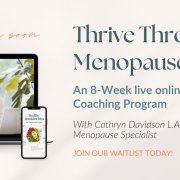
And if menopause is further along, our menopause care and the Thrive Through Menopause program with Cathryn Davidson go deeper still.
When Should I See My Doctor First?
Please do, and early. Perimenopause fatigue overlaps with thyroid disease, anemia, sleep apnea, and depression — conditions that deserve testing, and a simple blood panel rules out a lot. Acupuncture and TCM work beautifully alongside medical care (including hormone therapy, if that’s right for you); they’re not a reason to skip the workup.
The women who do best usually have a care team that talks to each other.
The Bottom Line:
Perimenopause fatigue is real, it’s physiological, and “just push through” is the worst advice you’ll get. It’s a pattern — hormonal swings, fractured sleep, a stressed nervous system, depleting reserves — and patterns can be treated. You don’t have to white-knuckle the next several years feeling like a phone stuck at 12%.
If you’re exhausted even when you sleep, we’d love to help you find the energy midlife keeps promising.
Main acupuncture clinic
Lokahi Wellness Space
408.279.9001
Instagram
This article is for informational purposes only and is not medical advice. Persistent perimenopause fatigue deserves medical evaluation to rule out thyroid disease, anemia, and other treatable causes. TCM care is complementary to, not a replacement for, medical management. If low energy comes with persistent low mood or hopelessness, please reach out to your physician — and we can help you find the right support.