Acupuncture and Swedish Massage Benefits: Nervous System Regulation after Trauma and Chronic Stress Management
June is PTSD Awareness Month. And while most people associate PTSD with a specific, identifiable event — combat, an accident, a single moment of loss — the reality of trauma is quieter and far more common than that framing suggests.
Trauma doesn’t always arrive with a clear before and after. Sometimes it accumulates slowly: years of chronic stress, a relationship that wore you down, a season of caregiving that left nothing for yourself, a body that learned to stay on guard because staying on guard felt safer than letting go. It doesn’t always look like crisis. Often it looks like a woman who can’t fully relax, even on vacation. A person who startles easily, sleeps lightly, and carries tension in places she’s stopped noticing. Someone who feels disconnected from her own body — not dramatically, just quietly, persistently.
This is what we mean when we say trauma lives in the body. And this is the kind of experience we hold space for at Lokahi.
The Body Keeps Score
The phrase has become familiar — but its implications are still underappreciated. When the nervous system experiences something overwhelming, it doesn’t file it away neatly and move on. It encodes it. The body learns to anticipate danger, to brace, to mobilize energy toward protection. These are not character flaws or signs of weakness. They are intelligent survival adaptations — responses that once served a very real purpose.
The challenge is that the nervous system doesn’t always know when the threat has passed. Long after the stressful circumstances have changed, the body can remain in a state of low-grade activation: muscles slightly braced, breath slightly shallow, digestion slightly suppressed, sleep slightly restless. The system is still watching. Still waiting. Still spending energy on protection that the present moment no longer requires.
Over time, this sustained activation takes a toll. Chronic fatigue, hormonal disruption, digestive irregularities, persistent anxiety, low libido, disconnection from pleasure — these are not separate problems. They are often the downstream effects of a nervous system that has never fully been given permission to rest.
What Chinese Medicine Understands About Held Stress
Traditional Chinese Medicine has its own language for what happens when stress and trauma become lodged in the body — and it has been describing these patterns for thousands of years.
In TCM, the Heart is the home of the Shen — the spirit, the mind, the part of us that feels safe enough to be present. When the Heart is settled, we sleep deeply, think clearly, and feel genuinely ourselves. When it is disturbed — by shock, grief, chronic fear, or sustained stress — the Shen becomes unsettled. Sleep grows shallow. Anxiety rises without clear cause. There is a sense of being unmoored from one’s own center.
The Kidneys in Chinese medicine govern our deepest reserves — the constitutional vitality that underlies everything else. Fear and sustained threat are understood to deplete the Kidneys specifically, which is why people who have lived through prolonged stress often describe a particular kind of bone-level exhaustion that sleep alone doesn’t touch.
The Liver governs the smooth flow of qi — the movement and expression of everything the body needs to circulate: blood, emotion, hormones, breath. When stress causes Liver qi to stagnate, the result is a body that feels simultaneously stuck and reactive. Tight. Braced. Prone to frustration or emotional flooding, followed by shutdown.
These patterns — unsettled Shen, depleted Kidneys, stagnant Liver qi — are not abstractions. They are recognizable. They are what we see in practice, in real people navigating real lives.
How Acupuncture Supports the Traumatized Nervous System
Acupuncture does not ask you to talk through what happened. It does not require a narrative. It works directly with the body’s physiology — and this is one of the reasons it can be so valuable for people whose nervous systems have been shaped by experiences that are difficult to put into words.
When fine acupuncture needles are placed at specific points on the body, they initiate a measurable physiological response. Research has shown that acupuncture activates the parasympathetic nervous system — the branch responsible for rest, repair, and digestion — while downregulating the sympathetic “fight or flight” response. It reduces circulating cortisol. It increases the release of endorphins and serotonin. It promotes vagal tone — a measure of the nervous system’s flexibility and resilience, its ability to move between states of activation and rest.
In clinical terms, acupuncture helps shift a system out of chronic sympathetic dominance and into a state where healing is actually possible. In the room, this often looks like a patient’s breath deepening within the first few minutes of treatment. Shoulders dropping. Jaw unclenching. The particular quality of stillness that comes when a body finally feels safe enough to stop bracing.
For people navigating trauma, anxiety, PTSD, or the quieter but still significant weight of chronic stress and burnout, this physiological shift is not a small thing. It is, for many, the first experience of genuine safety in the body that they’ve had in a long time.
Specific acupuncture points used in nervous system and trauma-informed treatment include:
- Du 20 (Baihui) at the crown of the head — settles the Shen, quiets mental restlessness, lifts the spirit
- Ren 17 (Shanzhong) at the center of the chest — opens the chest, releases held grief and anxiety, supports the Heart
- Heart 7 (Shenmen) at the wrist — the primary point for calming the mind and anchoring the spirit
- Kidney 1 (Yongquan) at the sole of the foot — grounds the system, reconnects the person to the present moment
- Pericardium 6 (Neiguan) at the inner forearm — eases anxiety, nausea, and emotional overwhelm
- Ear points (Shenmen, autonomic point, zero point) — used in trauma-specific protocols to calm the amygdala response and promote nervous system regulation
Treatment is always individualized. The intention is never to force or push — but to gently create the conditions in which the body remembers what safety feels like.
The Role of Swedish Massage in Nervous System Recovery
Touch is one of the most direct and ancient pathways to nervous system regulation — and for many people, it is also one of the most complicated. When the body has learned that the world is unsafe, being touched by another person can feel vulnerable in ways that are hard to articulate.
This is why the quality of the therapeutic relationship matters as much as the modality itself. At Lokahi Wellness Space, our massage therapists approach every session with attentiveness and care — aware that for some clients, simply lying still and receiving touch without having to do anything in return is itself a new and meaningful experience.
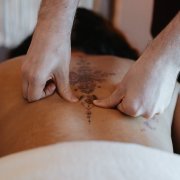
Swedish massage is particularly well-suited for nervous system support. Its defining characteristics — long, flowing effleurage strokes, gentle kneading, rhythmic compression — are specifically calibrated to activate the parasympathetic nervous system. The slow, predictable quality of the touch signals safety to a nervous system that has learned to expect the unexpected.
Physiologically, Swedish massage has been shown to reduce cortisol levels, lower heart rate and blood pressure, and increase serotonin and dopamine — the same neurochemical shifts that support mood stability, emotional resilience, and a sense of wellbeing. For clients dealing with anxiety, PTSD symptoms, or the effects of chronic stress, a regular Swedish massage practice is not a luxury. It is a legitimate therapeutic tool.
There is also something that happens in the body during a truly restful massage session that is difficult to quantify but unmistakable in experience: a person stops performing. Stops managing. Stops monitoring. The nervous system — if the conditions are right — exhales. This is the state in which repair happens. In which the body begins to update its assessment of the world from “threatening” to “safe enough.”
For clients who are also receiving acupuncture, Swedish massage works in beautiful complement. Where acupuncture works systemically — shifting the autonomic nervous system, regulating hormones, addressing deep constitutional patterns — massage works locally and somatically, releasing held tension in specific tissues, restoring circulation to areas that have been chronically braced, and reinforcing the parasympathetic signals that acupuncture initiates. Together, they speak to the body in different registers — and the body tends to listen more completely when it hears the same message more than once.
What “Trauma-Informed” Actually Means at Lokahi
Trauma-informed care is not a specialty service or a separate program. It is a way of being in relationship with patients — an attentiveness to the fact that every person who walks through our door is carrying something, and that the clinic environment itself can either reinforce a sense of safety or undermine it.
At Lokahi, this looks like:
Unhurried appointments. We do not rush. Your practitioner will sit with you, ask questions that go beyond your chief complaint, and listen to what you’re not sure is relevant. It is always relevant.
Practitioner consistency. Healing nervous system patterns requires relationship. When you see the same practitioner over time, the therapeutic relationship itself becomes part of the medicine — a repeated experience of being seen, being held, and being safe.
No pressure to disclose. You do not need to tell us what happened. You do not need to have a diagnosis or a clear explanation for why you feel the way you feel. Many of our patients come in knowing only that something is off — that they are more anxious, more exhausted, more disconnected from themselves than they want to be. That is enough to begin.
Education and agency. We explain what we are doing and why. We check in throughout treatment. Your comfort and sense of control are not secondary concerns — they are part of the therapeutic protocol.
This is what we mean when we say: You are heard here. Not as a tagline. As a practice.
You Don’t Have to Be in Crisis to Deserve Support
One of the things that keeps people from seeking care is the belief that what they’re carrying isn’t serious enough. That other people have it worse. That they should be able to handle it on their own.
We want to say clearly: the weight you’ve been managing quietly for years is real. The way your body learned to brace, to vigilate, to hold on — that cost something. And the path back to feeling genuinely at ease in your own body is available to you, regardless of how you got here or how long it’s been.
Acupuncture and massage don’t ask you to be in crisis to help you. They meet you where you are — and support your system in finding its way back to something that feels like home.
Ready to Feel Safe in Your Body Again?
At Lokahi Acupuncture and Lokahi Wellness Space in San Jose, we offer personalized acupuncture and Swedish massage for nervous system support, stress recovery, anxiety, and trauma-informed care. We’d love to be part of your healing.
Call us at (408) 279-9001 for a complimentary 15-minute consultation, or book online here.
Serving San Jose, Campbell, Los Gatos, Willow Glen, and the greater Silicon Valley area.
Lokahi Acupuncture
Free Consultation
408.279.9001
Follow us on Instagram
Make an Appointment