How Acupuncture and Massage Work Together to Release Emotional Stress
Unresolved emotional stress doesn’t just live in the mind — it’s held in the tissue, the nervous system, and the breath. Here’s what the research tells us about how the body stores what we don’t process, and how the combination of acupuncture and massage addresses both layers at once.
Acupuncture and Massage for Emotional Stress
There’s a phrase that’s moved from therapy offices into mainstream conversation over the past decade: the body keeps the score. It comes from Bessel van der Kolk’s book of the same name, and it names something most people recognize intuitively long before they have the language for it — the sense that emotional stress from months or years ago is somehow still present, carried in the shoulders, the jaw, the gut, the shallow breathing that never quite resolves.
The science behind this observation has grown substantially. Polyvagal theory, somatic experiencing, fascia research, and decades of HPA-axis studies now converge on a clear picture: unresolved emotional stress is not metaphorically “held in the body.” It’s physiologically encoded there, in nervous system patterns, muscular tension, and tissue changes that can persist long after the original situation has ended.
At Lokahi, this is one of the places where the combination of acupuncture and massage therapy does its most meaningful work. The two modalities address different layers of how stress gets stored, and together they often reach what neither can quite reach alone.
How emotional stress gets stored in the body
Emotional experiences don’t just get filed as memories. They produce physiological states — and when those states don’t get to complete their natural cycle of activation and release, they tend to persist.
Here’s the short version of what the research shows.
The nervous system gets stuck in activation
When you experience emotional stress — an argument, bad news, a sustained period of overwhelm — the sympathetic nervous system activates. Heart rate rises, muscles brace, breathing shifts, cortisol increases. In a regulated system, the activation peaks and then resolves, returning to parasympathetic baseline.
In chronic or unresolved stress, that return doesn’t happen cleanly. The autonomic nervous system can get stuck in hyperarousal (anxious, reactive, unable to relax) or shift into hypoarousal (numb, disconnected, flat). Both are, as polyvagal theory describes them, adaptive physiological states — not character traits or moral failings. They’re what the body does when the demand has exceeded its capacity to reset.
Implicit memory encodes experiences in the body
Explicit memory is what you consciously recall — the story of what happened. Implicit memory is different: it’s stored in the body as sensation, posture, breath pattern, and reflexive response. You can know cognitively that you’re safe in a crowded elevator and still feel your shoulders hike and your breath shorten. That’s implicit memory doing what it does.
For most people, implicit stress memory accumulates through ordinary life — work pressure, relationships, grief, chronic worry, sustained caregiving, the slow erosion of sleep. It doesn’t require trauma to show up as a tight diaphragm, a locked jaw, or a gut that never fully settles.
Fascia and muscle tissue change with sustained stress
The connective tissue throughout the body responds to chronic sympathetic activation by thickening and forming adhesions. Patterns of habitual tension — the “armoring” somatic practitioners describe — become structural over time. Patients often describe this as feeling braced without knowing against what.
The HPA axis and vagus nerve lose flexibility
Under sustained demand, the hypothalamic-pituitary-adrenal axis that produces cortisol becomes dysregulated, and vagal tone — the capacity of the parasympathetic nervous system to bring you back to baseline — weakens. The result is a system that stays activated for longer than needed and struggles to return to rest.
The cumulative picture: emotional stress leaves real, measurable imprints on the nervous system and tissue. Those imprints persist without a specific intervention to release them.
Why acupuncture and massage address different layers
Acupuncture and massage both support nervous system regulation, but they do it through distinctly different mechanisms. Understanding how they differ clarifies why the combination is often more effective than either alone.
What acupuncture does
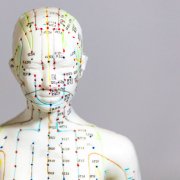
Regulates the autonomic nervous system directly. Acupuncture at specific points — particularly HT7 (Shenmen), PC6 (Neiguan), Yintang, and auricular points — produces measurable increases in vagal tone and heart rate variability, shifting the body out of sympathetic dominance. For a deeper look at this mechanism, we’ve covered it in detail in our piece on acupuncture for anxiety and the nervous system.
Modulates the HPA axis. Studies have documented acupuncture’s effect on cortisol regulation and stress-hormone signaling, with implications for chronic stress, sleep, and mood.
Addresses specific TCM patterns tied to emotion. In Chinese medicine, particular organ systems carry specific emotions. The Liver carries anger and frustration; the Heart carries joy and shock; the Spleen carries worry; the Lungs carry grief; the Kidneys carry fear. Liver qi stagnation — the most common pattern driving unresolved emotional stress — produces recognizable symptoms: chest tightness, jaw clenching, menstrual irregularities, irritability, a sense of pressure looking for release. Acupuncture treatment is tailored to the specific pattern presenting.
Shifts neurotransmitter activity. Endorphins, serotonin, GABA, and dopamine all respond to acupuncture, contributing to the subjective experience of calm and mood stabilization that patients often describe within a single session.
What massage does
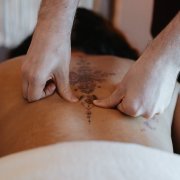
Directly releases the tissue. Therapeutic massage works on the physical layer — the muscles, fascia, and connective tissue that have held stress patterns for months or years. This is the layer acupuncture can influence indirectly but doesn’t physically reach. Deep tissue work, myofascial release, and neuromuscular techniques mechanically break up adhesions and restore sliding surfaces between tissue layers.
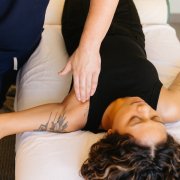
Activates parasympathetic tone through touch. Sustained, skilled touch is one of the most reliable triggers for parasympathetic activation. The vagus nerve responds to slow, rhythmic pressure and to the sensory input of being held safely. Many patients describe the shift on the table as unmistakable — a gradual but deep letting-go that no cognitive effort can produce.
Releases stored tension patterns physically. The “armoring” stored in the body isn’t just metaphorical. It’s visible and palpable in the tissue. Massage is the modality that addresses it at the physical level, allowing the body to begin releasing what it has been holding.
Supports interoception. Interoception — the ability to accurately sense what’s happening inside your body — tends to decrease under chronic stress. Regular massage gently restores this capacity, helping patients reconnect with sensation and notice tension before it becomes chronic.
Where they converge
Both modalities increase vagal tone, lower cortisol, and shift the nervous system toward parasympathetic dominance. But they enter the system through different doors. Acupuncture works neurologically and systemically — points on the body producing downstream effects through nerve pathways and endocrine modulation. Massage works mechanically and somatically — direct physical contact with the tissue holding the pattern.
When the two are used together, they reach both the neurological encoding of stress and the physical manifestation of it. For patients with layered, long-held emotional stress, this combination often produces changes that single-modality care has not been able to touch.
What this looks like in a coordinated care plan
For patients specifically addressing unresolved emotional stress, we typically structure care like this:
An initial acupuncture assessment to identify the primary TCM pattern driving the presentation — most often Liver qi stagnation, Heart-Kidney disharmony, or a combination. This gives us a clinical roadmap rather than a generic stress protocol.
Regular acupuncture sessions at the main clinic, typically weekly for the first four to six weeks. These address the nervous system, HPA axis, and underlying pattern. Many patients also benefit from Chinese herbal medicine prescribed to support the specific pattern between sessions.
Therapeutic massage at the Lokahi Wellness Space, spaced to complement the acupuncture schedule. For emotional-stress presentations, we often recommend massage work that blends modalities — some deep tissue where the tension is strongest, more relaxation-focused work where the nervous system needs down-regulation, adjusted based on how the body is responding.
A slower cadence over time as the nervous system stabilizes. Most patients find that after the initial intensive period, biweekly or monthly sessions are enough to hold the gains.
This isn’t rigid. Some patients start with massage and add acupuncture as they become ready to address deeper layers. Others start with acupuncture and add bodywork as the stored physical tension becomes more accessible. The two locations are across the parking lot from each other, and our practitioners communicate across both to keep care coordinated.
What to expect, and what this work is not
Releasing stored emotional stress through bodywork is often quieter than people expect. There are sometimes the more dramatic moments — spontaneous tears on the table, a long exhale that seems to carry something with it, a feeling of lightness that arrives unexpectedly — but more often the changes are subtle and cumulative. Patients describe sleeping more deeply. Feeling less reactive. Breathing without effort. Noticing that a tension pattern they’d carried for years has quietly softened.
A few important distinctions about what this work is and isn’t:
It’s not trauma therapy. Acupuncture and massage can meaningfully support the physical and nervous-system layer of trauma recovery, but they are not a substitute for working with a trained trauma therapist. For patients with significant trauma histories, we coordinate with mental health providers and position our work as one supportive piece of a broader plan.
It’s not a one-session reset. The encoding of chronic emotional stress develops over months or years. Its release follows a similar arc. Real change tends to show up over weeks, not hours.
It doesn’t require you to tell us your story. Some patients want to talk. Others want to be quiet on the table. Both are appropriate. The body responds to the physical work regardless of how much is said aloud, and we follow the patient’s lead on what feels right.
It’s not about catharsis. The goal isn’t to force an emotional release. The goal is to restore physiological flexibility — to help the nervous system regain the capacity to move between activation and rest the way it’s meant to.
When to consider this approach
Combined acupuncture and massage is worth considering if:
- You’ve been carrying emotional stress, grief, or a life transition that hasn’t resolved the way you expected
- You notice physical patterns — tight chest, locked jaw, gut tension, shallow breath — that track with emotional states
- Talk therapy has been helpful but hasn’t fully reached the physical layer of what you’re experiencing
- You’re between therapists, out of therapy, or looking for body-based support alongside other work
- You recognize that you’ve been living in a braced state for a long time and want to help your body find its way back
We’d love to talk with you about what coordinated care across our two locations could look like for what you’re navigating.
Book a consultation at Lokahi →
Our main acupuncture clinic and Lokahi Wellness Space are located across the parking lot from each other in San Jose, making integrated care genuinely accessible rather than logistically complicated.
Lokahi Acupuncture
Free Consultation
408.279.9001
Follow us on Instagram
Make an Appointment
This article is for informational purposes only and is not medical advice. Acupuncture and massage can complement mental health care but are not substitutes for therapy, psychiatric treatment, or trauma-specific care. If you’re experiencing significant trauma symptoms, please consult a qualified mental health professional.