How Chronic Stress Affects Women’s Hormones and Skin, and What Actually Helps
Chronic stress doesn’t stay in your head. It travels — through the nervous system, into the endocrine system, and onto your skin. Here’s what’s happening at each layer, and the integrative approach we use at Lokahi to interrupt it.
Chronic Stress and the Body’s Cascade
Most of what gets written about chronic stress focuses on how it feels — the tightness in your chest, the racing thoughts, the exhaustion that doesn’t lift with sleep. That’s real, and it matters. But stress is also a measurable physiological event, with a predictable sequence of downstream effects that women, in particular, tend to experience on multiple levels at once.
The nervous system activates. Hormones shift in response. The skin — the largest endocrine organ in the body — registers those shifts visibly. By the time patients come to Lokahi concerned about hormonal symptoms or changes in their complexion, the cascade has usually been running for months or years.
This piece walks through that cascade in plain terms — what’s happening at each layer, why women experience it differently than men, and how we use the combination of acupuncture, therapeutic massage, and facial rejuvenation acupuncture to interrupt it at each stage.
Layer 1: The nervous system and the HPA axis
Every stress response begins the same way. The hypothalamus releases corticotropin-releasing hormone (CRH), which signals the pituitary to release ACTH, which tells the adrenal glands to produce cortisol. This is the hypothalamic–pituitary–adrenal (HPA) axis — the body’s central stress response system.
In acute stress, this cascade is useful and self-limiting. Cortisol rises, the threat resolves, cortisol drops, the system resets.
In chronic stress, the system doesn’t reset. Cortisol stays elevated, circadian rhythm flattens, and the HPA axis either becomes hyperactive (high cortisol all the time) or progressively desensitized (low cortisol and exhaustion). Both patterns are now recognized as HPA axis dysfunction, and both have systemic consequences beyond how you feel in the moment.
Where the Wellness Space fits in
Therapeutic massage directly addresses this layer. The physical pressure of skilled bodywork activates the parasympathetic nervous system, lowers cortisol measurably, and interrupts the sympathetic dominance that chronic stress creates. This isn’t the relaxation-as-luxury narrative — it’s measurable nervous system regulation that, done consistently, retrains the baseline tone of the HPA axis.
For patients whose primary stress symptoms show up as muscle tension, headaches, poor sleep, or the sense of not being able to switch off, regular massage at our Lokahi Wellness Space is often where the work begins.
Layer 2: Reproductive hormones — why chronic stress hits women differently
This is where things get specifically gendered. The HPA axis and the hypothalamic–pituitary–gonadal (HPG) axis — the system that governs estrogen, progesterone, and the menstrual cycle — are deeply intertwined. When cortisol runs high, reproductive hormone signaling is affected in several specific ways.
-
GnRH suppression. Elevated cortisol inhibits the hypothalamus’s release of gonadotropin-releasing hormone, which in turn disrupts LH and FSH. The result can be delayed ovulation, skipped cycles, or functional hypothalamic amenorrhea.
-
Loss of progesterone’s buffering effect. Progesterone normally has a calming influence on the HPA axis. When stress drives hormonal shifts that reduce progesterone availability, the stress response becomes less dampened — which perpetuates the cycle.
-
Estrogen variability. Estradiol modulates HPA axis reactivity, and fluctuations across the menstrual cycle mean the same stressor can feel dramatically different at different cycle points.
-
Thyroid effects. Chronic stress reduces conversion of T4 to active T3, contributing to the fatigue, brain fog, and weight gain many women describe as “something’s off but my labs are normal.”
-
Perimenopause and menopause. As estrogen and progesterone decline, their buffering effect on cortisol diminishes. Stress genuinely is worse in perimenopause — not because you’re handling it poorly, but because your biochemical shock absorbers are depleting.
This is the layer most women describe as “I don’t feel like myself.” Irregular cycles, PMS that used to be manageable, sleep disruption that tracks with hormonal shifts, mood changes that feel bigger than the circumstances warrant. The labs are often normal or borderline. The experience is unmistakable.
Where the main acupuncture clinic fits in
This is acupuncture‘s domain. The evidence base for acupuncture in stress-related hormonal dysregulation is substantial, with effects documented on cortisol regulation, HPA-HPG axis modulation, and specific conditions like PCOS, PMS, perimenopausal symptoms, and cycle irregularities.
From a Traditional Chinese Medicine perspective, the most common pattern driving stress-related hormonal symptoms in women is Liver qi stagnation — often combined with Kidney deficiency (particularly as women approach perimenopause) or Spleen qi deficiency (when fatigue and digestion are prominent). Identifying the specific pattern shapes the treatment protocol for chronic stress.
Patients experiencing the hormonal layer of stress — whether that’s cycle irregularity, menopausal symptoms, or stress-driven fertility concerns — typically work with our acupuncturists at the main San Jose clinic, often with herbal medicineas an adjunct.
Layer 3: The skin
The skin is not a passive reflection of what’s happening underneath. It’s an active endocrine organ with its own local cortisol production, its own stress response pathways, and its own measurable damage profile under chronic HPA activation.
Recent research has mapped this in detail. A 2025 study in the Journal of Cosmetic Dermatology examined the impact of moderate psychological chronic stress on skin function and documented:
-
Collagen breakdown. Cortisol significantly downregulates collagen type I, collagen type III, and HSP47 — the chaperone protein that supports collagen folding. Elastin network integrity is similarly compromised.
-
Barrier dysfunction. Transepidermal water loss increases measurably in chronically stressed subjects, making skin more reactive, dehydrated, and prone to irritation.
-
Impaired wound healing. Fibroblast growth factor 7 is downregulated and periostin gene expression drops by approximately 80%, slowing skin’s repair processes.
-
Oxidative DNA damage. Cortisol and epinephrine produce measurable oxidative lesions in both keratinocytes and fibroblasts, accelerating cellular aging.
-
Barrier recovery delays. Studies have documented that chronic stress — even something like exam stress or relationship stress — measurably delays the skin’s ability to recover after disruption.
On top of this, cortisol drives sebum production (contributing to adult hormonal acne), triggers inflammatory cascades (worsening rosacea, eczema, and psoriasis), and amplifies vascular reactivity (the “stress flush”). Add in the estrogen decline of perimenopause, which reduces skin thickness and collagen density on its own, and the combined effect is striking.
Where the Wellness Space fits in again
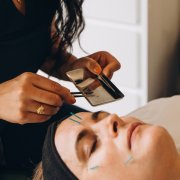
Facial rejuvenation acupuncture at our Wellness Space addresses this layer through two simultaneous mechanisms.
The local effect: fine needling stimulates collagen and elastin production at the dermal level, improves facial circulation, and supports lymphatic clearance — directly counteracting the collagen breakdown, dullness, and barrier compromise that chronic cortisol produces.
The constitutional effect: facial acupuncture protocols include body points that address the internal patterns driving the skin changes. For stress-driven skin concerns specifically, this systemic layer is often what produces lasting improvement rather than temporary smoothing.
For more on the mechanisms, we’ve written in depth about facial acupuncture and the benefits of microneedling, both of which apply directly to stress-related skin changes.
Why integrated care works better than single-modality care
The cascade described above is not three separate problems. It’s one physiological process expressing itself on three layers simultaneously. Treating only the skin with topicals ignores the hormonal driver. Treating only the hormones ignores the nervous system input. Treating only the nervous system leaves the downstream skin changes unaddressed.
This is why patients at Lokahi often end up working across both of our locations for chronic stress. A typical integrated protocol for stress-related hormonal and skin concerns might include:
-
Weekly or biweekly acupuncture at the main clinic, addressing the HPA-HPG axis, the underlying TCM pattern, and any cycle-related or menopausal symptoms
-
Monthly therapeutic massage at the Wellness Space, sustaining parasympathetic tone and releasing the muscular patterns that chronic stress creates
-
A series of facial rejuvenation sessions at the Wellness Space (typically 6–10, then monthly maintenance) addressing the skin-layer effects directly
-
Herbal medicine and lifestyle support coordinating the internal work across modalities
Patients can start anywhere in this system. Some come in for facial acupuncture and discover they want to address what’s driving the skin changes. Some come in for stress or menopausal symptoms and add facial work as the hormonal picture stabilizes. Some start with massage and build outward as they begin to feel the difference consistent nervous system regulation can make.
The point isn’t to book every service. It’s to recognize that stress shows up in layers, and that the most durable results come from addressing it in layers.
What actually helps
The research is consistent, and so is what we see in our practice. For stress-related hormonal and skin concerns, the interventions that produce lasting change share a few characteristics:
-
They’re regular, not occasional. One massage or one acupuncture session doesn’t retrain a dysregulated HPA axis. Consistency is what moves the needle — typically over weeks to months, not days.
-
They address the nervous system directly. Cognitive strategies matter, but physiological interventions that activate parasympathetic tone produce measurable biochemical change in a way that mindset alone doesn’t.
-
They’re integrated with sleep, nutrition, and movement. No clinical protocol substitutes for the foundational work of adequate sleep, stable blood sugar, and regular moderate exercise.
-
They respect the individual pattern. Stress is universal, but how it expresses is specific — and treatment that’s tailored to the actual pattern driving your symptoms works better than generic protocols.
If you’re noticing that stress is showing up in your cycle, your sleep, your energy, or your skin — and you’d like to explore what an integrated approach could look like for you — we’d love to talk.
Book a consultation at Lokahi →
Our main acupuncture clinic and Lokahi Wellness Space are both in San Jose. Patients often work across both locations as part of a coordinated care plan.
Lokahi Acupuncture
Free Consultation
408.279.9001
Follow us on Instagram
Make an Appointment
This article is for informational purposes only and is not medical advice. Always consult your primary care provider or specialist for medical concerns, particularly regarding hormonal symptoms that may require diagnostic workup.