Spring Muscle Stiffness: How Deep Tissue Massage Restores Range of Motion
The first warm weekend of the year brings gardens, hikes, bike rides, and — 48 hours later — a body that feels a decade older than it should. Here’s what’s actually happening in the tissue when seasonal activity catches your muscles off guard, and how deep tissue massage restores the range of motion you’ve lost over winter.
Spring Muscle Stiffness
It’s a pattern we see every March and April at Lokahi. The weather turns. The first genuinely warm Saturday arrives. You finally pull the bike out of the garage, spend three hours in the garden, take the long hike you’ve been thinking about all winter — or more often, all three in one weekend.
By Monday, something is wrong. The lower back that was fine on Friday is locked. The hips don’t want to flex the way they used to. The shoulders carry a tightness that stretching doesn’t touch. You’re not injured, exactly — but you’ve lost noticeable range of motion, and it’s not coming back on its own the way it would have in your twenties.
This is spring muscle stiffness. It has a specific physiology, a specific cause, and a specific treatment approach that tends to work faster than most people expect.
What actually happens to your body over winter
The shift from winter to spring is harder on the musculoskeletal system than most people realize, because the preceding months set it up.
Over a typical Bay Area winter — shorter days, colder mornings, less time outside, more hours at a desk — activity levels drop significantly for most people. The drop doesn’t need to be dramatic to produce measurable changes. Research on deconditioning shows that the body starts to adapt to reduced activity within two to three weeks, and the effects are cumulative.
Four things are happening simultaneously:
Fascia densifies. The connective tissue that surrounds every muscle, organ, and nerve in your body responds to reduced movement by thickening and becoming less mobile. Studies have documented measurably higher concentrations of hyaluronic acid in stiff tissue compared to normal controls, along with reduced shear strain — the fascia’s ability to glide over itself and over the muscles it encases. People with chronic lower back pain, for example, have about 20% less thoracolumbar fascial shear strain than those without.
Joints lose range of motion. Joint capsules tighten, synovial fluid flow decreases, and the small ligamentous and capsular structures that allow smooth movement become less pliable. This happens quietly and cumulatively — you don’t notice it during winter because nothing is asking much of those joints.
Muscles lose elastic quality. The viscoelastic properties of muscle depend on regular loading. Without it, muscle fibers adapt to the shorter range they’re being used in. The hip flexors of someone who sat at a desk all winter genuinely have less functional length than those of someone who hiked weekly.
The nervous system recalibrates. Proprioception — your body’s sense of where it is in space — dulls with reduced varied movement. Coordination patterns that required no thought in October require more conscious attention by March.
None of this is catastrophic on its own. But when you ask a winter-deconditioned body to do three hours of gardening or a long first-ride-of-the-year, you’re loading tissue and joints that aren’t ready for that load. The muscle stiffness that follows is the body’s signal that the demand has exceeded current capacity.
Why your usual stretching isn’t cutting it
One of the more frustrating aspects of spring muscle stiffness is that the coping tools that usually work — stretching, foam rolling, a hot shower — only help temporarily. The tightness returns within hours.
There’s a mechanical reason for this. Stretching and foam rolling work primarily at the muscle level. But recent research suggests that much of what we experience as “muscle soreness” and “stiffness” is actually happening in the fascia — specifically, in the extracellular connective tissue that surrounds and connects muscle fibers.
A 2021 paper in the International Journal of Molecular Sciences proposed that delayed-onset muscle soreness may be better understood as a fascial phenomenon rather than a purely muscular one, driven by free nerve endings in the connective tissue responding to mechanical and inflammatory signals.
Fascia doesn’t respond to stretching the same way muscle does. Densified fascia — tissue that has thickened and lost its glide — requires direct mechanical intervention to release. This is why a hot shower loosens you temporarily but the stiffness comes back: the underlying restriction hasn’t actually been addressed, just masked by a brief increase in blood flow and tissue warmth.
This is the gap deep tissue massage fills.
How deep tissue massage restores range of motion
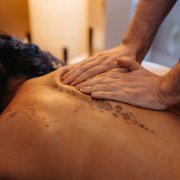
Deep tissue massage works through mechanical pressure and direct contact with the fascial and deeper muscular layers that winter deconditioning affects most. The specific mechanisms matter here because they’re different from what stretching, foam rolling, or Swedish massage can achieve.
It mechanically releases densified fascia
Sustained, slow pressure applied along the length of muscle fibers breaks up the hyaluronic acid–related densification that accumulates in stuck fascia. This isn’t metaphorical “breaking up adhesions” language — it’s a measurable mechanical effect that restores shear strain and allows the tissue to glide properly again. Once fascia moves correctly, the muscles it encases can lengthen and contract through their full range.
It restores sliding surfaces between tissue layers
Muscles, fascia, and the sheaths between them are designed to glide over each other as you move. When these sliding surfaces become stuck, movement that should be smooth becomes restricted. Deep tissue work targets these interfaces specifically, using pressure and directional strokes to restore the glide that normal movement depends on.
It deactivates trigger points
The knotted areas of hyperirritable tissue that most people call “knots” are trigger points — localized areas of sustained contraction within a larger muscle. They refer pain to other areas, limit range of motion, and don’t resolve on their own. Sustained direct pressure deactivates them, and once they release, the muscle around them can function normally again.
It down-regulates the nervous system
Here’s the less obvious piece: stiff tissue is partly a nervous system phenomenon. Muscles that have been in a guarded state stay that way until the nervous system receives clear signals that it’s safe to let go. The pressure of deep tissue work, combined with the parasympathetic activation that comes from sustained skilled touch, provides those signals. Range of motion often improves not just from the mechanical release but from the neural down-regulation that allows the tissue to stop bracing.
It addresses the pattern, not just the site
Spring muscle stiffness rarely shows up in isolation. The lower back that locks up on Monday is usually connected to tight hip flexors, compensating glutes, and restricted thoracic rotation. A skilled deep tissue session treats the whole pattern — following tension from where you feel it back to where it’s actually coming from. This is why a single focused session often produces changes that weeks of targeted stretching haven’t.
A TCM lens on the spring transition
In Traditional Chinese Medicine, spring is associated with the Liver — the organ system responsible for the smooth flow of qi throughout the body. When the Liver is functioning well, movement is fluid and tension resolves quickly. When Liver qi is stagnant — which happens commonly after a sedentary winter combined with lingering stress — the body holds tension, movement becomes restricted, and small stressors produce outsized physical reactions.
Deep tissue massage supports this seasonal reset in a way that parallels the TCM understanding. Physically moving the tissue, releasing areas of held tension, and restoring circulation aligns with the spring-Liver principle of unblocking stagnant qi and allowing free movement. We’ve covered the broader TCM seasonal framework in our piece on spring skincare the TCM way, which applies the same underlying philosophy to a different system.
How to approach your first weekend of spring activity
If you’re reading this before the first big weekend of activity, a few practical principles help significantly.
Respect the gap. Whatever you did easily last October, assume your current capacity is 70-80% of that. Plan accordingly. The three-hour garden session doesn’t need to happen all at once. The long first hike can be shorter.
Warm up for longer than feels necessary. Deconditioned tissue needs more time to become pliable. Ten minutes of easy movement before you start working or riding is worth the time.
Book a session in the week after. This is the single most useful thing you can do. One deep tissue session 48-72 hours after a big weekend of activity interrupts the stiffening pattern before it becomes chronic.
Don’t push through locking tightness. If your body has genuinely stiffened up — if you can’t rotate, can’t flex forward, can’t reach overhead through your normal range — rest and get treatment. Pushing through doesn’t train the tissue; it produces strain.
When to consider deep tissue massage
Spring muscle stiffness is worth addressing with deep tissue work if:
- You did a significant amount of activity after a less-active winter and your body hasn’t recovered within a few days
- You’ve noticed that your range of motion has shifted over the winter and you want to restore it before summer activity ramps up
- You’re planning a bigger project — a cycling season, a hiking trip, a training cycle for a race — and want to start with a body that’s physically ready
- You have specific areas (lower back, hips, shoulders, neck) that feel locked and haven’t responded to stretching or self-massage
- You’re noticing that the same stiffness pattern returns every spring, and you want to interrupt it for good
For some patients, pairing deep tissue work with acupuncture accelerates the process — particularly when there’s nervous system involvement, stress that’s compounding the physical restriction, or chronic patterns that have persisted for more than one season. The combination addresses both the mechanical and neurological layers of stiffness at once, and we’ve written more about how the two modalities work together in our piece on acupuncture and massage for emotional stress.
If you’re feeling the first-weekend-of-spring pattern this year and want to restore range of motion before it becomes chronic, we’d love to see you.
Book a deep tissue massage at Lokahi →
Our Lokahi Wellness Space offers deep tissue massage with therapists who specialize in releasing seasonal tension patterns and restoring full range of motion.
Lokahi Wellness Space
Book Your Massage
408.279.9001
Follow us on Instagram
This article is for informational purposes only and is not medical advice. If muscle stiffness is severe, accompanied by sharp pain or numbness, or doesn’t improve with rest and treatment, consult a medical provider to rule out injury or other underlying causes.