Acupuncture and Massage Therapy for Athletes
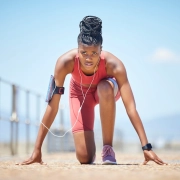
Repetitive movement stress is the invisible wear pattern underneath most of the injuries active people actually get. Here’s how the same movement, done thousands of times, shapes your body — and how acupuncture and massage therapy for athletes address what no single sport or training plan ever does on its own.
Acupuncture and Massage Therapy for Athletes
Most injury conversations in athletics focus on acute events — the ankle you rolled, the hamstring that went on the track, the shoulder that popped during the lift. Those are visible, diagnosable, and easy to talk about.
The harder pattern — and the one we see more often at Lokahi — is the slow accumulation of repetitive movement stress. The tennis player whose serving shoulder has quietly lost 15 degrees of internal rotation. The cyclist whose hip flexors never fully extend anymore. The golfer whose thoracic rotation is asymmetrical. The swimmer with the impingement pattern that’s been creeping in for two seasons. The climber whose pinky flexors are a little more alive than the rest of their forearm.
None of these athletes are injured in a way a scan would pick up. All of them are carrying wear patterns that will become injuries if left unaddressed. And these are exactly the patterns that acupuncture and massage therapy are particularly well-suited to address — reaching the tissue and nervous system layers that training and stretching don’t quite get to.
This piece is organized by movement archetype, because that’s how repetitive stress actually works in the body.
What repetitive movement stress actually is
Before the archetypes, the mechanism. A few things happen when the body performs the same movement thousands of times:
Muscle imbalance develops predictably.
Agonist muscles (the movers) get strong and short. Antagonists (the stabilizers) get overstretched and weak. The imbalance isn’t a flaw — it’s what the body does in response to what you’re asking of it. But it creates uneven loading across joints, which sets up the next step.
Fibrous adhesions form in the soft tissue.
Repeated microtrauma to muscle fibers, fascia, and tendon sheaths triggers a low-grade inflammatory response. The body heals these tiny injuries, but the healing process includes the formation of scar-like adhesions between tissue layers that were designed to glide over each other. Over time, these adhesions restrict range of motion, alter force transmission, and pull on adjacent structures — muscle, fascia, tendon, bursa — in ways that produce the pain patterns athletes know well.
The kinetic chain compensates.
Bodies are remarkably good at finding ways to perform a movement even when part of the system isn’t working well. A restricted hip leads to compensatory rotation through the lumbar spine. A tight shoulder recruits the neck and upper traps. The compensations work — until they don’t. Most chronic athletic pain is traced back, on examination, not to the site of pain but to a compensatory pattern that started somewhere else.
The nervous system reinforces the pattern.
Motor patterns that are repeated become neurologically ingrained. The brain’s representation of a movement — its motor schema — stabilizes around what you’ve been practicing, including any compensations. This is why changing a stroke, a swing, or a running form takes deliberate, sustained retraining.
Repetitive movement stress, then, is the combined result of muscular imbalance, soft tissue adhesion, compensatory kinetic chain dysfunction, and neural entrenchment. It’s a layered problem, and it responds best to layered treatment.
The overhead athlete: tennis, swimming, volleyball, climbing
The pattern
Any athlete who repeatedly moves the arm overhead develops a recognizable set of imbalances in the shoulder complex. Sports medicine literature calls one version of this “upper crossed syndrome”: upper trapezius, levator scapulae, pectoralis major, and anterior deltoid become overactive and tight, while lower and middle trapezius, serratus anterior, rhomboids, and deep neck flexors become weak. The scapula sits in protraction and elevation, the shoulder loses internal rotation, and the subacromial space narrows — which is the mechanism behind rotator cuff tendinopathy and impingement syndromes.
For the tennis player, this shows up as serving shoulder pain. For the swimmer, it’s swimmer’s shoulder. For the volleyball hitter, it’s anterior shoulder ache during or after hard sessions. For the climber, it’s often lat-pec-shoulder tightness that won’t release with stretching.
Where acupuncture fits
Acupuncture addresses this pattern at two levels. At the local musculoskeletal layer, needling the trigger points in the affected muscles — subscapularis, infraspinatus, teres minor, the scalenes — produces measurable release and pain modulation. Systematic review data supports acupuncture’s role in shoulder impingement, rotator cuff tendinopathy, and related upper-extremity musculoskeletal pain.
At the systemic level, the nervous system down-regulation that acupuncture produces helps interrupt the guarding patterns that keep these muscles locked. Patients often describe their shoulder “finally letting go” during or after a session in ways that stretching and self-massage haven’t achieved.
Where massage fits
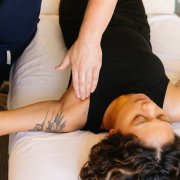
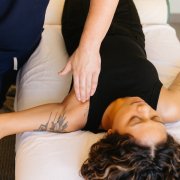
This is where deep tissue work is especially valuable. The adhesions and shortened tissue in the upper chest, shoulder, and lateral neck need direct mechanical release. A skilled therapist working through the pectorals, subclavius, and anterior deltoid, then across into the lats, teres major, and the rotator cuff, can restore shear between tissue layers that weeks of stretching cannot replicate. Combined with appropriate strengthening of the posterior chain between sessions, this is the combination that durably shifts the pattern.
The endurance athlete: running and cycling
The pattern
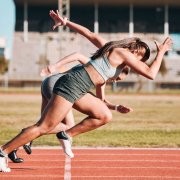
Endurance sports produce a different imbalance profile. The dominant pattern is anterior-chain dominance with posterior-chain restriction: tight hip flexors, overactive quadriceps, underactive glutes and hamstrings, shortened calves, and thoracic extension limitation. Hours in the same sagittal plane — pedaling or running — without varied movement produces deep fascial stiffening along the entire front line, which travels from the tops of the feet up through the shins, quads, hip flexors, abdominal fascia, and into the neck.
For runners, this pattern produces the familiar cascade: plantar fasciitis, shin splints, patellofemoral pain, IT band syndrome, and chronic low back tightness. For cyclists, it’s hip and lower back pain, anterior knee pain, and the neck/upper back tightness that comes from hours in the riding position.
Where acupuncture fits
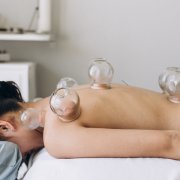
Acupuncture has a documented role in several of these conditions specifically — we covered this in detail in our piece on acupuncture for runners and muscle recovery. The evidence is strongest for plantar fasciitis and patellofemoral pain syndrome, where systematic reviews consistently show meaningful pain reduction and functional improvement. For the broader pattern — chronic hip flexor tightness, lumbar tension, calf adhesion — acupuncture addresses the trigger points, local circulation, and nervous system regulation that let the tissue start to change.
Where massage fits
The anterior chain of an endurance athlete is usually where sports massage does its most important work. Direct release of the iliopsoas through the abdomen, deep work into the adductors and quadriceps, thoracolumbar fascia release, and attention to the calves and plantar fascia can restore length to structures that have been progressively shortening. For athletes in active training, sessions scheduled 24-48 hours after hardest workouts are most effective — giving the nervous system time to shift out of sympathetic dominance while still addressing accumulated load.
The asymmetric athlete: golf, baseball, racquet sports
The pattern
Any sport where force production is asymmetric — a golf swing, a baseball pitch, a tennis serve — produces asymmetric tissue adaptation. The dominant side develops different length-tension relationships than the non-dominant side. Rotational sports specifically create torque patterns through the thoracic spine, obliques, and hip complex that are measurably different side-to-side.
For golfers, this shows up as lead-side low back pain, trail-side hip tightness, and loss of thoracic rotation. Baseball pitchers develop well-documented “GIRD” (glenohumeral internal rotation deficit) on the throwing shoulder, along with lat and posterior capsule tightness. Racquet-sport athletes — tennis, pickleball, squash — develop the same asymmetric patterns, often with the added complication of the repetitive eccentric load at the wrist and elbow that drives lateral and medial epicondylitis.
Where acupuncture fits
Acupuncture is particularly useful for the pain patterns asymmetric athletes develop. Lateral epicondylitis (tennis elbow) has one of the more robust evidence bases in sports acupuncture — systematic reviews support both manual acupuncture and dry needling, with dry needling showing superior long-term effects. For the rotational restriction through the thoracic spine and hip complex, acupuncture’s effect on releasing myofascial trigger points and restoring nervous system balance is often where change begins.
Where massage fits
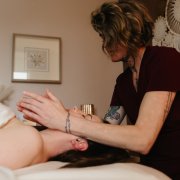
For asymmetric athletes, bodywork needs to address the imbalance explicitly rather than treating both sides equally. This is where experienced practitioners matter. A session that works the dominant-side lats, obliques, and rotational fascia — while also releasing the non-dominant compensators — can begin to restore rotational symmetry in a way that training alone will not. Over a series of sessions, many asymmetric athletes recover range of motion they had assumed was permanently lost.
The strength and power athlete: weightlifting, CrossFit, strongman
The pattern
Strength athletes develop a different profile again. The dominant pattern is overall high muscle tone with localized hot spots — tight upper traps, locked thoracic spine, overactive erectors, shortened hip flexors and adductors, and chronic tightness through the wrists, elbows, and shoulders from heavy loaded positions. Unlike endurance athletes, strength athletes usually have strong posterior chains — the problem is rarely weakness but rather overall systemic tension and localized fascial restriction.
The classic injuries in this population — shoulder impingement, low back strain, hip impingement symptoms, patellar tendinopathy, elbow and wrist tendinopathies — reflect tissue that’s been asked to repeatedly produce high force in specific positions without adequate recovery or mobility work to match.
Where acupuncture fits
For strength athletes, acupuncture’s systemic effects are often as valuable as its local ones. The sympathetic dominance that accompanies heavy training compounds tissue tension and slows recovery. Regular acupuncture shifts the nervous system toward parasympathetic recovery mode, supports sleep quality, and addresses the specific pain patterns — shoulder, elbow, knee, low back — that heavy lifting produces. For tendinopathies specifically, acupuncture’s effect on local circulation to tissue that has poor baseline vascular supply is one of the more valuable contributions it makes.
Where massage fits
Strength athletes often need the deepest, most sustained bodywork of any athletic population. The tissue is dense, the tension is layered, and generic relaxation massage doesn’t reach it. Deep tissue work, trigger point therapy, and attention to the fascial lines that run through heavily loaded positions — thoracolumbar, anterior hip, medial and lateral arm — can restore the mobility that makes training sustainable. We’ve written about this pattern specifically in our piece on therapeutic massage benefits for long-term mobility.
Why combining both modalities works better
The archetypes above each describe a different imbalance pattern, but they share something in common: the problem exists on multiple layers at once. Muscle, fascia, trigger points, nervous system, kinetic chain compensation. No single intervention reaches all of these.
Acupuncture works through the nervous system.
It modulates pain centrally and peripherally, shifts autonomic balance, regulates the HPA axis, and produces local effects at needled points. What it doesn’t do — or doesn’t do as directly — is physically release the tissue that’s been adhering for months or years.
Massage works mechanically.
It addresses the adhesions, the shortened tissue, the densified fascia, and the trigger points through direct pressure and movement. What it doesn’t do as well as acupuncture is produce the systemic nervous system shift or the regulatory effect on pain modulation pathways.
Used together, they reach both layers.
Athletes who alternate between the two — or who do one modality one week and the other the next — consistently report better, faster, and more durable change than athletes using either alone. For a more detailed look at how these modalities complement each other in practice, we covered it in our piece on acupuncture and massage working together to release stress.
How to build acupuncture and massage into your training year
A few practical principles that tend to work well for athletes across archetypes:
During active training: Weekly or biweekly sessions, alternating between acupuncture and massage. Schedule the deeper bodywork sessions 48-72 hours after your hardest training sessions of the week, when tissue recovery is most receptive.
During taper or pre-competition: Shift toward acupuncture rather than aggressive bodywork. The nervous system regulation and sleep support matter more than deep tissue release at this stage.
Post-race or post-competition: One session of each within the first week, ideally starting with lighter bodywork and moving toward deeper work as the acute soreness resolves.
Off-season or base phase: Monthly maintenance of both, with occasional targeted sessions if a specific niggle develops. Off-season is also the right time to work on the chronic imbalance patterns that active training doesn’t allow you to address.
Returning from injury: A coordinated plan across modalities — acupuncture for pain modulation and circulation to the injured tissue, massage for the compensatory patterns that developed during injury, and progressive return to full training load. Injury rehabilitation is a context where integrated care produces meaningfully better outcomes than any single modality.
When to start
If you’re an active person carrying any of the patterns described above — the restriction that doesn’t respond to stretching, the pain that keeps coming back in the same spot, the sense that your body is less mobile than it was a season or two ago — this is the work to do. Not after it becomes an injury. Before.
Athletes who maintain regular integrated care across acupuncture and massage tend to stay in their sport longer, recover more consistently, and require fewer interventions for acute injuries, because the patterns that produce those injuries get addressed before they escalate.
If you’re ready to build this kind of care into your training, we’d love to talk.
Book a consultation at Lokahi →
Our main acupuncture clinic and Lokahi Wellness Space are located across the parking lot from each other in San Jose, with practitioners across both who specialize in working with athletes — from endurance runners and cyclists to racquet sport players, lifters, and climbers.
Lokahi Wellness Space
Book Your Massage
408.279.9001
Follow us on Instagram
This article is for informational purposes only and is not medical advice. For any acute or significant sports injury, consult a sports medicine physician, orthopedic specialist, or physical therapist for proper diagnosis and treatment planning.