Can TCM Help with Pain Management for Endometriosis?
Endometriosis affects roughly one in ten women — and takes, on average, the better part of a decade to diagnose. By the time most patients reach us, they’ve lived years inside a cycle of chronic discomfort, been offered a short menu of hormonal options and surgery, and learned to phrase the question carefully: can TCM actually help, or is this just another thing to try? It’s the right question, and it deserves a straight answer.
The Cycle of Chronic Discomfort
Endometriosis is tissue similar to the uterine lining growing where it shouldn’t — on ovaries, ligaments, bowel, bladder — responding to every hormonal cycle with inflammation that has nowhere to go. But the disease is only half the story. The other half is what years of it does to the body’s pain systems.
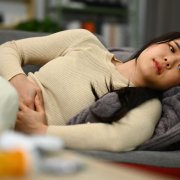
Pelvic pain that fires month after month teaches the nervous system to expect it — the central sensitization we’ve written about in chronic headaches, turned up further by the pelvic floor muscles that brace protectively around every flare. Over time, three layers fuse into one experience: the lesions and inflammation, the guarded pelvic floor and fascial restriction, and a sensitized nervous system with pain volume stuck high. Add the exhaustion, the cycle-dread, and the toll on work and relationships, and “chronic discomfort” starts to look like the polite term for it.
This layering explains a frustrating clinical fact: even after excision surgery removes the lesions, pain persists in a significant share of patients — because the other two layers were never treated. It also explains why TCM, which treats all three layers at once, earns its place in endometriosis care.
How TCM Reads Endometriosis
TCM’s classical category for endometriosis is blood stasis — blood that should flow being stuck, pooling, forming masses, and causing the signature stabbing, fixed-location pain. The pattern usually rides on something else: cold constricting circulation, Qi stagnation from chronic stress, or underlying depletion. Two patients with the same diagnosis routinely receive different treatment — one warming and moving, another moving and building — because their patterns differ.
What’s striking is how well the old language maps onto current research: impaired pelvic microcirculation, inflammatory stagnation, adhesions binding tissue that should glide. “Blood stasis” turns out to be a serviceable clinical shorthand for all three.
What the Evidence Actually Shows
The research base here has grown substantially, and it’s better than most people — including many physicians — expect:
- A 2024 systematic review and meta-analysis found acupuncture reduced overall pelvic pain and menstrual pain in endometriosis compared with sham acupuncture — low-to-moderate certainty evidence, but in the right direction against a real control
- A 2025 meta-analysis of nine randomized trials (535 patients) found acupuncture significantly reduced pain intensity and more than doubled clinical response rates versus controls
- A 2024 network meta-analysis of 42 trials with over 3,600 participants found that combination therapy — acupuncture plus Chinese herbal medicine — outperformed Western medication alone on pain scores, CA-125 levels, and response rates
- Reviews also report improved quality of life and reduced recurrence — outcomes that matter as much as the pain score
The honest caveats, because they matter: many included trials are small, study quality varies, and acupuncture protocols differ across studies. No responsible practitioner should claim TCM cures endometriosis or replaces excision surgery and hormonal management where those are indicated. The accurate claim is narrower and still significant: for pain management for endometriosis, acupuncture and herbal medicine have meaningful randomized-trial support — particularly in combination, and particularly as an addition to conventional care rather than a replacement for it.
What Treatment Looks Like
Endometriosis care at Lokahi is a long-game protocol, not a quick fix — because the condition is cyclical, treatment works with the cycle:
- Acupuncture timed to your cycle — moving blood and calming the nervous system in the lead-up to menstruation when the pain builds, supporting and rebuilding in the weeks after. Treatment also works the sensitization layer directly: downshifting the stress response, improving sleep, lowering the baseline the pain fires from
- Customized herbal formulas from our dispensary — the combination approach the network meta-analysis found most effective. Formulas are adjusted across the cycle and across months as the pattern shifts
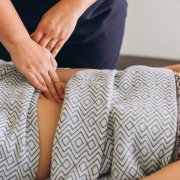
- Bodywork for the guarded pelvis — abdominal and structural massage at our Wellness Space addresses the fascial and muscular layer, and we refer to and work alongside pelvic floor physical therapists, whose work pairs naturally with ours
- The foundations — the anti-inflammatory, blood-sugar-steady eating pattern from our cycle nutrition guide supports everything above
Expectations, honestly set: most patients notice change within two to three cycles — less pain-day intensity, fewer flare days, better energy — with deeper change over six months. We track it cycle by cycle, because trend is the only honest measure with a cyclical disease.
A note on fertility: endometriosis and fertility concerns often arrive together, and the same blood-moving, inflammation-calming treatment serves both goals. If that’s part of your picture, our fertility care integrates it into one plan.
Working With Your Medical Team
TCM works best here as part of a team. Keep your gynecologist; if you’re considering excision surgery, see a specialist — and use acupuncture and herbs to manage pain meanwhile, support recovery after, and address the layers surgery can’t reach. New or rapidly worsening pelvic pain, pain with fever, or pain outside your usual pattern needs medical evaluation first. We coordinate with physicians routinely, and the patients who do best are usually the ones whose care teams talk to each other.
The Bottom Line
Can TCM really help with endometriosis and pelvic pain? The evidence says yes — meaningfully, for pain, quality of life, and recurrence, especially when acupuncture and herbal medicine work together alongside conventional care. What it offers that nothing else in the treatment landscape quite does: an approach built for chronic, cyclical, multi-layer pain — treating the stagnation, the guarding, and the sensitization as one pattern, month by month.
If you’ve been cycling through chronic pelvic pain and wondering whether anything else is worth trying — this is, and we’d be glad to talk it through with you.
Book a consultation at Lokahi →
Our main acupuncture clinic and Lokahi Wellness Space are both located in San Jose.
Lokahi Acupuncture
Free Consultation
408.279.9001
Follow us on Instagram
Make an Appointment
This article is for informational purposes only and is not medical advice. Endometriosis diagnosis and surgical decisions belong with your gynecologist; TCM care described here is complementary to, not a replacement for, conventional medical management. Do not stop prescribed treatment without consulting your physician.